
Essential Car Trailer Features to Look For
Choosing the right car trailer is about more than finding a trailer that can carry a vehicle. The right combination of capacity, construction, loading features, braking systems and secure tie-down points can make vehicle transport safer, easier and more efficient.
Whether you are transporting a car, 4WD, SUV, race car or vehicle for recovery work, understanding the essential features to look for will help you choose a trailer that suits your vehicle and towing requirements.
At Century Trailers, car trailers are available in manual tilt and hydraulic tilt configurations, with ATM ratings ranging from 2.8T to 4.5T and deck sizes up to 5m x 2m.
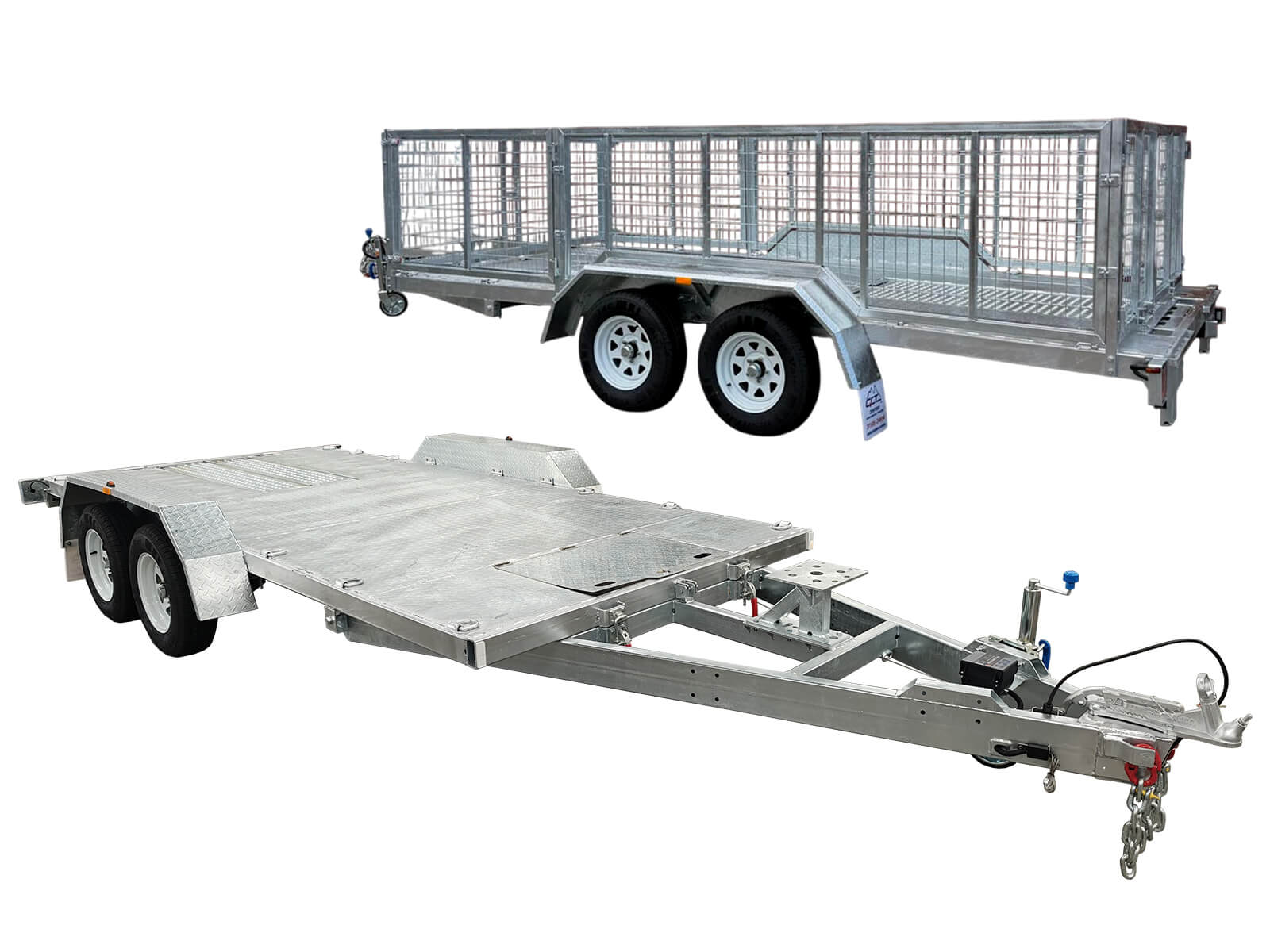
1. The Right ATM Rating
One of the first specifications to check when choosing a car trailer is its Aggregate Trailer Mass (ATM).
ATM refers to the maximum allowable loaded mass of the trailer, including the trailer itself and its load. Your trailer’s ATM needs to be appropriate for the vehicle you intend to transport and must also be compatible with your tow vehicle’s towing capacity.
For example, Century Trailers offers car trailers with ATM options from 2,800kg through to 4,500kg, depending on the model.
Before purchasing, consider:
- The kerb weight of the vehicle you plan to transport
- Any additional equipment or accessories
- The trailer’s own tare mass
- The towing capacity of your vehicle
- The relevant legal weight limits
Choosing a trailer with sufficient capacity gives you more flexibility while helping prevent overloading.
2. A Strong, Durable Chassis
A car trailer needs to withstand the weight of vehicles as well as the stresses created during loading, unloading and towing.
Look for a fully welded, heavy-duty chassis designed for the intended application. Galvanised steel construction is also a valuable feature for Australian conditions because it provides protection against corrosion.
Century Trailers’ car trailer range features fully welded hot-dip galvanised chassis construction, designed to provide strength and corrosion resistance.
A strong chassis is particularly important if you plan to use your trailer regularly for commercial transport, vehicle recovery or machinery hauling.
3. Suitable Deck Size
The trailer deck needs to accommodate the length and width of the vehicles you intend to carry.
A deck that is too short or narrow can make loading difficult and may not provide adequate positioning for your vehicle. Consider the vehicle’s:
- Overall length
- Overall width
- Wheelbase
- Ground clearance
- Tyre position
- Weight distribution
Century Trailers’ car trailers include deck sizes of approximately 4.8m x 2m and 5m x 2m, providing options for different vehicle transport requirements.
Always measure your vehicle rather than relying solely on its model name or category.
4. Manual Tilt or Hydraulic Tilt
The loading system is another important consideration.
A tilt car trailer allows the deck to angle during loading, helping create a smoother approach for vehicles. Manual tilt systems can be a practical choice for occasional vehicle transport, while hydraulic tilt systems can make frequent loading and unloading more convenient.
Hydraulic tilt can be especially useful when transporting vehicles with low ground clearance or when a trailer is being used regularly for recovery or commercial work. Century Trailers offers both manual and hydraulic tilt car trailers.
When comparing models, consider how frequently you will load vehicles and how much effort you want to spend on setup and loading.
5. Integrated Loading Ramps
Good loading ramps can make a significant difference when loading a vehicle.
Look for ramps that are:
- Strong enough for the intended load
- Securely stored when not in use
- Easy to position
- Suitable for the vehicle’s ground clearance
- Designed to provide a stable loading surface
Some Century Trailers car trailer models use sink-in steel ramps, which help improve ground clearance and reduce the risk of damage underneath the trailer during loading.
For low-clearance vehicles, ramp design and loading angle are particularly important.
6. Multiple Tie-Down Points
Once your vehicle is loaded, it needs to remain securely positioned throughout the journey.
Look for a car trailer with multiple, conveniently positioned tie-down points or rails. These give you greater flexibility when securing vehicles of different sizes and wheel positions.
For example, Century Trailers’ 4.8m x 2m car trailer features full-length tie-down rails for securing transported vehicles.
The tie-down system should work with appropriate vehicle restraints and be positioned so that the vehicle can be secured without putting unnecessary stress on vulnerable components.
7. Reliable Braking System
Braking is a critical consideration when towing a heavy vehicle trailer.
Heavier car trailers should have an appropriate braking system that works with the tow vehicle and complies with applicable Australian requirements.
Century Trailers’ car trailer range includes electric brakes and a breakaway safety system.
When comparing trailers, don’t simply look at whether brakes are fitted. Make sure the braking setup is appropriate for the trailer’s rated mass and compatible with your tow vehicle.
Always check current Australian and state or territory requirements before towing.
8. Tandem Axles for Heavy-Duty Applications
The axle configuration can influence stability, load distribution and overall towing performance.
For heavier vehicle transport applications, tandem axle car trailers can provide a robust platform designed for higher-capacity applications.
Century Trailers’ car trailer models include tandem-axle configurations, with options extending to 3,500kg and 4,500kg ATM depending on the model.
When selecting an axle configuration, consider the trailer’s intended load, frequency of use and the towing capabilities of your vehicle.
9. Galvanised Finish for Corrosion Resistance
Car trailers are exposed to rain, road spray, dirt and changing weather conditions. Over time, moisture and road contaminants can contribute to corrosion, particularly when trailers are used frequently.
A hot-dip galvanised finish can provide an additional layer of protection for steel components.
Century Trailers uses hot-dip galvanised steel chassis construction across its car trailer range, helping improve durability in demanding Australian environments.
A durable finish can also help reduce long-term maintenance requirements, although regular cleaning and inspection are still important.
10. A Practical Drawbar and Safety Chain Setup
The drawbar transfers towing forces between the trailer and tow vehicle, so its construction should match the trailer’s intended capacity.
For heavy-duty car trailer applications, look for a robust drawbar and properly rated safety chains and connections.
Century Trailers’ car trailer range includes models featuring 150mm x 50mm drawbars, while some models use hammerlock-connected safety chains.
As with all towing equipment, ensure the coupling, chains and associated components are correctly rated and installed.
11. A Floor Surface Suited to Your Application
The deck surface can affect traction, drainage, cleaning and loading.
Century Trailers offers car trailers with checker plate and punched/perforated floor options.
A checker plate deck provides a solid platform, while a punched or perforated deck can offer different characteristics for drainage and vehicle transport.
Think about where and how you will use the trailer before choosing a deck style.
12. Ease of Use and Maintenance
A trailer should not only be strong—it should also be practical to operate.
Consider features such as:
- Easy-access tie-down points
- Convenient ramp storage
- Simple tilt operation
- Accessible components for inspection
- Quality wheels and tyres
- Replaceable wear components
- Easy cleaning and maintenance
If the trailer will be used regularly, small convenience features can make a major difference over time.
What Should You Prioritise When Buying a Car Trailer?
Not every buyer needs the same specification. Your priorities should depend on how you plan to use the trailer.
| Feature | Why It Matters |
|---|---|
| ATM rating | Determines the trailer’s maximum loaded mass |
| Deck size | Ensures your vehicle can be loaded safely |
| Chassis construction | Provides structural strength and durability |
| Tilt system | Makes vehicle loading easier |
| Loading ramps | Helps create a practical loading approach |
| Tie-down points | Allows secure vehicle restraint |
| Electric brakes | Provides controlled braking for heavier trailers |
| Breakaway system | Adds an important safety feature |
| Tandem axles | Suitable for higher-capacity applications |
| Galvanised chassis | Helps resist corrosion |
| Deck style | Influences loading, drainage and everyday use |
Choosing the Right Car Trailer for Your Needs
The best car trailer is not necessarily the largest or most heavily equipped model. It is the one that provides the right combination of capacity, dimensions, construction, braking, loading and securing features for the vehicles you intend to transport.
Century Trailers offers a range of manual tilt and hydraulic tilt car trailers, including 4.8m x 2m and 5m x 2m deck options and ATM ratings from 2.8T to 4.5T.
Before making a decision, check your vehicle’s dimensions and weight, confirm your tow vehicle’s towing capacity, and consider how frequently you will load and transport vehicles.
Explore Car Trailers from Century Trailers
If you’re looking for a car trailer for sale in Brisbane, Gold Coast, Caboolture or Toowoomba, explore the Century Trailers car trailer range to compare manual tilt, hydraulic tilt, checker plate and punched-floor options.
With the right specifications and features, a quality car trailer can make vehicle transport safer, more efficient and far more convenient.